Welding of stainless steel, aluminium, steel and cast iron. We weld structures and assemblies to the highest quality requirements, including stainless steel assemblies suitable for the food industry.
Materials machined: all types of steel and non-ferrous metals
Production volumes: prototypes, one-off, small and medium batch production
Technical documentation: we manufacture from 2D drawings, 3D models, physical samples and other technical documentation
Production services: manufacture and repair of equipment and assemblies, welding of structural components
Industries served: furniture, automotive, aerospace, defence, pharmaceutical, food and more
Documentation: WPS and WPQR provided on request
Independent inspection: we arrange weld inspection and certification by accredited bodies
Logistics: manufacturing in Kaunas, delivery in Lithuania and abroad
Metal welding examples
Welding differs from our other services in one respect: the result can’t be redone. An inaccurately milled part can often still be corrected, but a bad weld means cutting it out and starting again. That is why what matters most here is not speed, but the welder’s experience and the right settings for the specific material.
We weld both individual assemblies and large structures – for new machines, prototypes and repairs of existing equipment. Stainless steel for the food and pharmaceutical industries deserves a special mention: there the weld must be not only strong but also completely tight and smooth, with no crevices where dirt could collect. For such assemblies we use TIG.
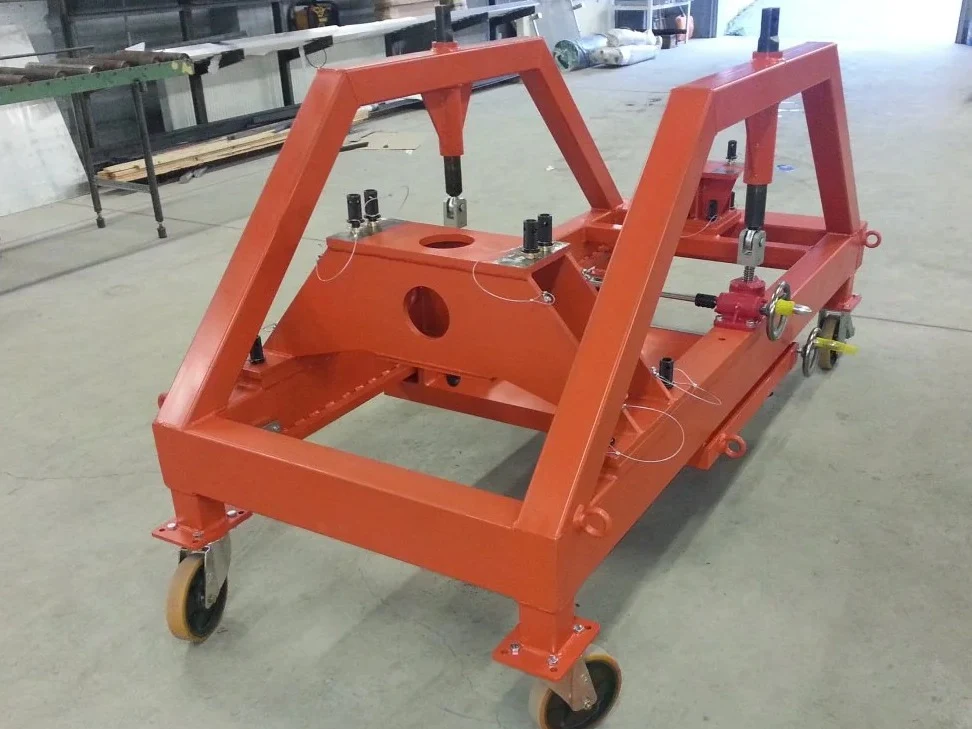
Steel trolley
Stainless steel lamellas
Platform with hoist
Metal welding services
Welding of structural components: we provide strong, reliable welding for various structural components, ensuring long-term durability.
Welding for special orders: we take on special orders, adapting to the unique needs and requirements of our customers.
New equipment manufacturing: we weld steel, stainless steel and aluminium for the manufacture of new or prototype machines and assemblies.
Machinery and equipment manufacturing and repair: we carry out welding related to the manufacture and repair of machinery and equipment, guaranteeing high quality and reliability.
Aluminium welding
We weld aluminium using TIG and MIG, from 3 mm thickness. After welding, we can mill and turn the parts in our own workshop, so you receive a finished part from one manufacturer.
Alloys we weld
6000 series (Al-Mg-Si): EN AW-6060, 6063, 6082
5000 series (Al-Mg): e.g. EN AW-5454 / AlMg3
Pure aluminium: EN AW-1050 (Al 99.5)
Products and limits
Typical products: frames, housings and other structural assemblies
Thickness: from 3 mm
Not welded: 2000 series (e.g. 2024) and 7000 series (e.g. 7005, 7020) alloys
Quality assurance and documentation
In many industries, a good weld is not enough – you have to prove it is good. We have both the qualifications and the documents to do so.
Qualifications and procedures
Certified welders: the work is done by a team with proven qualifications, not a random contractor
WPS – Welding Procedure Specification: a document stating the parameters to which a specific joint must be welded
WPQR – Welding Procedure Qualification Record: proof that a joint welded to that procedure meets the requirements
Independent inspection
External audit: when needed, we engage accredited independent inspection bodies to assess weld quality
Inspection certificates: we provide official documents issued by the inspecting body
When it is needed: most often in defence, aerospace, pharmaceutical and food industry projects, or when required by the customer’s internal procedures
If your project requires welding documentation or independent inspection, let us know when you send your enquiry. We assess this in advance so there are no surprises later – neither in lead times nor in price.
How do we handle orders?
01
Enquiry
We carefully review the 2D drawings, 3D models and technical specifications you provide, and assess the part geometry and material properties.
02
Quotation
We agree on the manufacturing technology, tolerances, quantities and lead times, and provide an accurate quotation. Once the order is confirmed, the project goes straight into our production schedule. If needed, we also arrange additional services (heat treatment, anodising, galvanising, etc.).
03
Production
We manufacture using modern equipment. To ensure full compliance with the technical requirements, we carry out strict measurement and quality control both during and after machining.
04
Logistics
We pack products securely to protect surfaces from damage and deliver them to the agreed address on time.
How to submit an enquiry
The more precise your enquiry, the faster you get a price. A drawing and the quantity are usually enough, but if you have more information, send it straight away – it saves extra questions.
File formats
3D models: STEP (.stp, .step), IGES, Parasolid, SolidWorks
2D drawings: DWG, DXF, PDF
No CAD files? A good-quality photo or scan of the drawing also works
Repairing existing equipment? Photos and a description of the damaged area are enough
Useful to include
Quantity: a single part or a batch – this determines the technology and price
Material and thickness: this determines whether MIG/MAG or TIG is suitable
Purpose of the structure: what loads or conditions it must withstand
Weld requirements: whether tightness, cosmetic quality or grinding is needed
Lead time: when the part is needed on site
We treat drawings and technical information as confidential – we do not share them with third parties or use them for other orders.
Materials used in manufacturing
We use only high-quality, certified materials. Taking into account your project requirements, operating conditions and loads, we help you choose the optimal material.
Steel: 1.0038 (S235JR) and more
Stainless steel: 1.4301 (AISI 304), 1.4404 (AISI 316L) and more
Cast iron: EN-GJL-250, EN-GJS-400 and more
Pure metals: copper, aluminium, titanium and more
Frequently asked questions
Metal welding is a thermal process in which, using heat, pressure or both, the edges of separate metal parts are joined into a single permanent, durable structure.
We provide welding services from our production base in Kaunas – for customers in Lithuania and across Europe.
The choice between TIG and MIG/MAG welding depends on the material, its thickness, the purpose of the structure and the quality requirements:
MIG/MAG welding: a productive and versatile process, ideal for joining thick metals (carbon steel, stainless steel and aluminium) and large structures. Thanks to its high speed and ease of automation, MIG/MAG is the main choice in series production, the machinery industry and the assembly of large metal bodies and frames.
TIG welding: a somewhat slower process than MIG/MAG that can join parts without filler or with a special wire for thicker structures. TIG welding is often used for thin metal sheets, parts, precision assemblies and pipework. Thanks to its flawless weld appearance, complete tightness and hygiene, TIG welding is indispensable in the food and pharmaceutical industries.
Not sure which method suits your structure? Send us a drawing or photo – we’ll suggest a solution.
Advantages:
High mechanical strength: a professionally made weld is usually as strong as the base material, and in some cases even stronger.
Tightness and permanence: creates a completely tight (gas- and liquid-proof) and durable joint that needs no additional sealing.
Lightweight construction: compared with bolted or riveted joints, welding adds no extra weight.
Design and geometry freedom: allows joining parts of complex shape, profiles of different thicknesses and pipework where other joining methods are impossible.
Automation potential: MIG/MAG and laser welding processes are easy to robotise, ensuring high productivity in series production.
Limitations:
Material compatibility limits: not all metals are easy to weld, and direct welding of dissimilar metals (e.g. aluminium to steel) is extremely difficult or impossible.
Permanent joint: a welded structure cannot be dismantled without damaging the parts themselves, which makes repairs or modular transport harder.
Have a project?
Share your project requirements by email and we will prepare a tailored quotation. We are also happy to advise on early-stage projects – helping you assess needs and options and find the optimal solution.